First, it’s all anybody seems to be talking about these days, but generally? I think there are good uses, and then there are stupid uses. Good uses such as: universal translator (why don’t we have one yet? Because racism, probably). Stupid uses such as: substituting an AI engine for a basic internet search. AI engines have data and statistics; they don’t have judgement. And they probably never will. Check out the latest of John Scalzi’s blog posts on the topic HERE.
My employer is using ChatGPT for some purposes. People at my level in the organization have been encouraged to take training on it and find uses that suit our job parameters. I personally will not spend a single minute training an AI how to do my job until I am forced to.
During a recent meeting when we were asked if we were using it and how, three people responded. Their uses boiled down to: I use it to write for me because I don’t know how to write; I use it to do internet research because it’s easier than thinking up properly limited search terms.
The problem is, of course, using ChatGPT or any of the others to write or think for you will not teach you to write or think. You will simply continue self-limiting your competency and your usefulness. And eventually the machine will do the job you used to do.
The Wall Street Journal, which my parents have subscribed to for decades because my Dad worked in investments, keeps publishing pro-AI editorials. The latest was titled “AI Is a Gift to Human Creativity.” The author, Brian J. Gross, is pushing the idea that AI can relieve humans of all the pesky drudgery and leave them free to, IDK, become Leonardo da Vinci.
In reality, of course, what people become when they refuse to do the work of learning their craft or their trade is … LAZY. And incapable. And thus unemployable.
Gross actually points out that technology can’t replicate judgement, taste, voice, or imagination. All it can do is mash together other people’s work - the millions of works created by actual humans and fed into the machines, mostly without compensation to the authors - leaving the human in the role of editor. But the ugly truth of humanity is: a lot of people are lazy. They will do the least amount of work possible. The thousands of “books” written by ChatGPT and the others, and paid for by readers, are proof that people don’t necessarily want the best, most original work: they want something predictable, just like what they’ve read before, with a few factors changed to make it “new.” And a machine can do that now, so actual human creators have less of the market share every year.
Gross thinks that regulators could and should shape the use of AI in the creative economy, but that ship has sailed. You can’t put the machine back in the bottle. DJT just wrote another executive order stomping on the states’ rights to regulate AI. It will get tied up in court, like many of his other BS orders, but in the meantime, the people who used DOGE to infiltrate federal databases and steal millions of citizens’ private information are using that information to shape the way AI interacts with all the technology we use every day. Such as the new Kindle “ask this book” feature, which seems to amount to having an AI read the book for you and give you the highlights.
C.M. Kornbluth wrote a brilliant story about the end stage of human civilization called “The Marching Morons.” Every time I look at the news, I think “Yep, you saw it, buddy.”
An earlier WSJ editorial on the topic was titled “AI Revolution Will Bring Prosperity.” That one’s by Phil Gramm and Michael Solon, who want to compare the so-called AI Revolution to the Industrial Revolution of the late 1700s - early 1800s. I had a lot of oh-hell-no points ricocheting around my brain, but ultimately I just want to leave it at the illustration that went with the editorial. An illustration that looks like it was made in 1895, and which perfectly encapsulates the worldview of people who make their living puffing up the latest investment bubble.
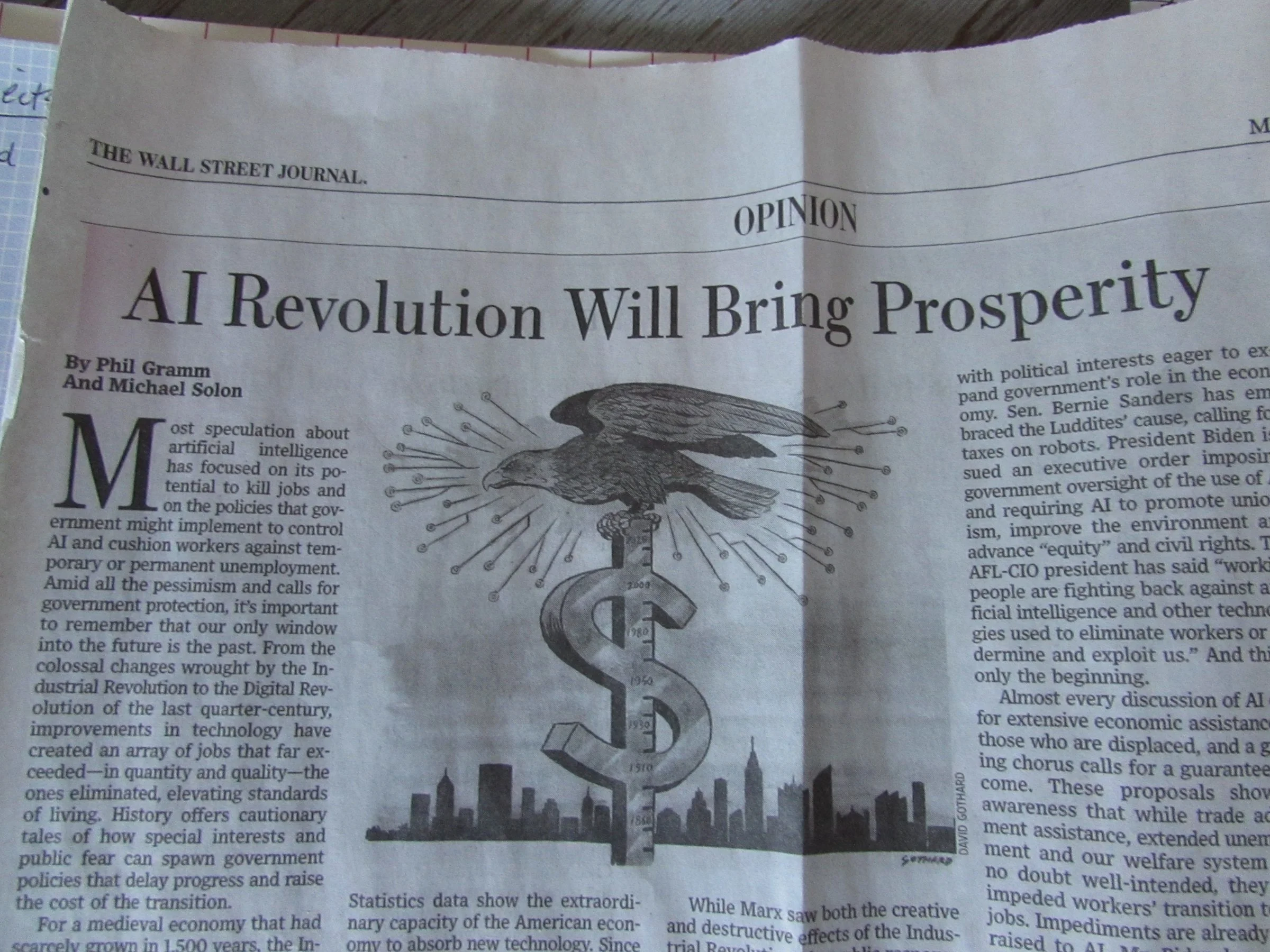
The AI Revolution is a bubble, and it’s stupid. At some point, the AI industry will contract to uses in which computing power can actually achieve social or industrial goals - like the universal translator or automated factories.
But what happens when factories are automated is the same thing that happened in the early 1800s when machinery put thousands of craftspeople out of work: you end up with a lot of formerly-skilled workers now forced to take unskilled work in order to make ends meet. A lot of people starving and rioting about it, too.
Meanwhile, the people who own the factories will do what such people always do: get richer.
AI cannot grow food crops, or manage livestock, or build houses, or knit a sweater. Not until it is being used to automate those functions, which means human beings will no longer have those jobs. Human beings who are out of work and bereft of income don’t generally turn around and become Leonardo da Vinci. They become starving, furious, and destructive.
Which is great for the rich guys, if their goal is another world war and millions of people dead. The rich guys are well on their way to making that happen, and they’re writing policy using AI because they can’t even be bothered to read a book.
This blog post, like all content on this site, was written entirely by the human being named Alexandra Y. Caluen. She likes doing research and thinking.